Government Team and World Bank Delegation Discuss Strengthening Partnership and Expanding Development Support
World Bank
Meeting
30/03/2026
Aden
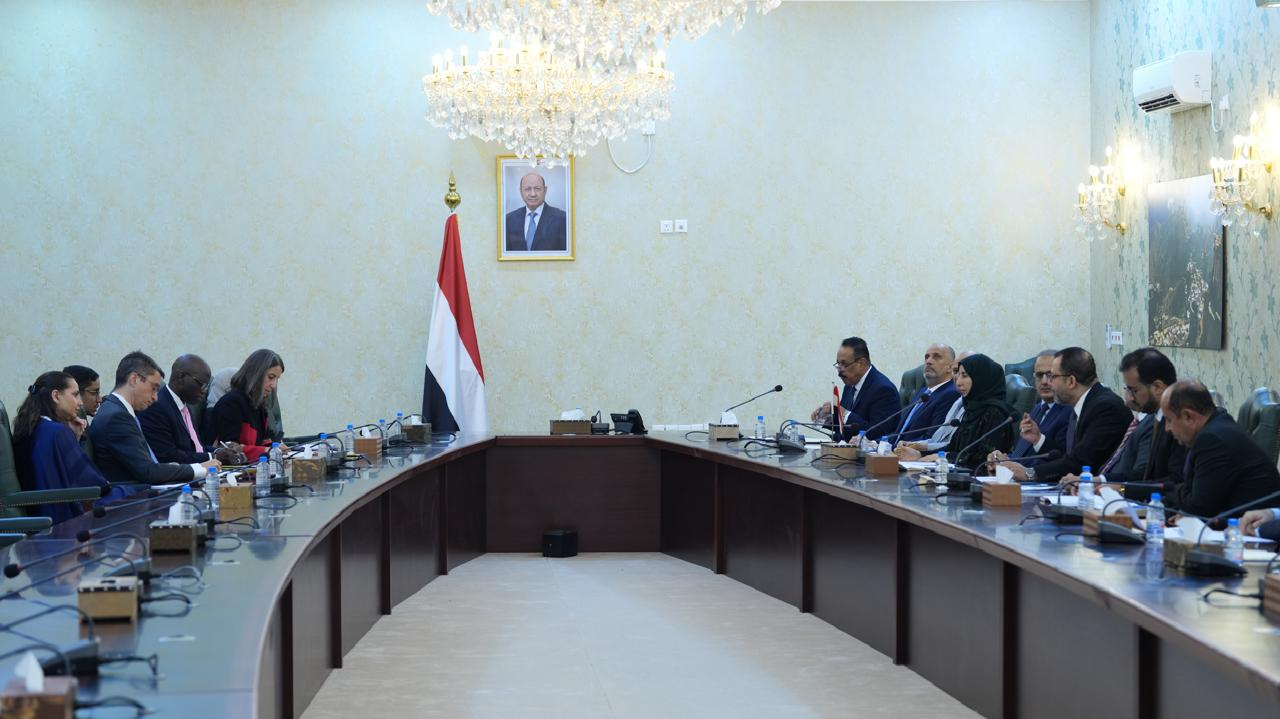
A high-level meeting was held today in the temporary capital, Aden, chaired by Minister of Planning and International Cooperation and Governor of Yemen to the World Bank Group, Dr. Afrah Al-Zouba, with a senior World Bank delegation led by Ousmane Dione, World Bank Vice President for the Middle East and North Africa, Afghanistan, and Pakistan, to discuss ways to strengthen the partnership and expand support for Yemen’s development, humanitarian, public service, and economic sectors.
The government delegation included Minister of Water and Environment Eng. Tawfiq Al-Sharjabi, Minister of Public Health and Population Dr. Qasem Buhaibeh, Minister of Finance Marwan Faraj Bin Ghanem, Minister of Electricity and Energy Eng. Adnan Al-Kaf, Minister of Public Works and Highways Eng. Hussein Al-Aqraabi, Minister of Education Dr. Adel Al-Abbadi, Minister of Civil Service and Insurance Salem Al-Awlaqi, Deputy Minister of Social Affairs and Labour Dr. Sadiq Al-Jamaei, Assistant Secretary-General for Planning at the Cabinet Secretariat Fadl Al-Shaeri, as well as deputy ministers and senior officials from the Ministries of Agriculture, Irrigation and Fisheries, Industry and Trade, and Public Works and Highways.
The meeting reviewed the World Bank’s portfolio of projects across several sectors aimed at improving public services, strengthening economic and financial management, enhancing institutional capacity, and supporting sustainable development. Key initiatives discussed included public financial management reform, financial management systems modernization, the national strategy for international trade facilitation, resilience and livelihoods programmes, humanitarian response and nutrition, human capital development, salary assessments, and civil service and human resources reform.
Government representatives outlined the challenges facing public institutions as a result of Yemen’s exceptional circumstances and the resulting economic and service delivery pressures. They also presented the priority needs identified by national institutions, emphasizing the importance of aligning these priorities with the World Bank’s strategic partnership framework to maximize sustainable development impact, strengthen national institutions, build local capacity, and ensure greater participation of qualified Yemeni professionals in implementing development programmes and projects.
Dr. Al-Zouba noted that the government has approved its annual programme of work across all national sectors and implemented a package of economic and fiscal reforms reflecting a comprehensive approach based on the National Development Plan. She explained that these reforms are intended to promote economic growth, accelerate recovery, and improve public services, while emphasizing the importance of strengthening coordination with the World Bank in project implementation, monitoring, evaluation, and impact assessment.
For his part, Ousmane Dione reaffirmed the World Bank’s commitment to its longstanding partnership with Yemen and its continued support for both the government and the Yemeni people. He explained that the Bank’s strategy in Yemen is built around three main priorities: improving nutrition, expanding access to electricity services, and strengthening the agriculture and fisheries sectors.
The World Bank Vice President also reaffirmed the Bank’s commitment to providing technical, operational, and institutional support, advancing the localization of development and humanitarian efforts, and taking into account the government’s recommendations and priorities during discussions on the World Bank’s new Country Partnership Framework, which is scheduled for consideration in May.