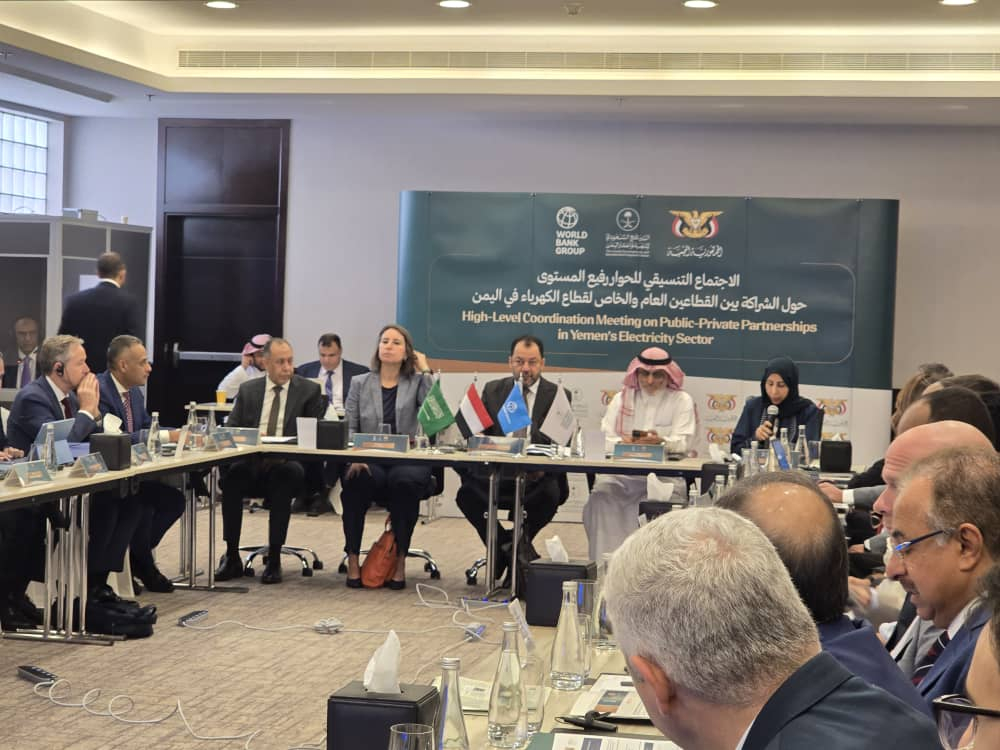
Ministerial Delegation Participates in High-Level Public–Private Dialogue on Yemen’s Electricity Sector
SDRPY
Meeting
11/05/2026
Riyadh
A Yemeni ministerial delegation participated today in the High-Level Public–Private Dialogue on Yemen’s Electricity Sector, jointly organized in Riyadh by the Saudi Development and Reconstruction Program for Yemen (SDRPY) and the World Bank Group.
The delegation included Minister of Planning and International Cooperation Dr. Afrah Al-Zouba, Minister of Electricity and Energy Eng. Adnan Al-Kaf, and Minister of Industry and Trade Mohammed Al-Ashwal. The event also brought together representatives from the Saudi Development and Reconstruction Program for Yemen, led by Assistant Supervisor General for Programs Eng. Hassan Al-Attas, as well as representatives of the World Bank Group, the International Finance Corporation (IFC), the Multilateral Investment Guarantee Agency (MIGA), Yemeni private sector representatives, Saudi companies, and international energy firms.
Over the course of two days, participants are discussing a series of specialized topics, including public-private partnership models suited to Yemen’s context, the legislative and regulatory framework for the electricity sector, risk mitigation instruments, the “Revitalizing the Electricity Sector for a Just Transition” initiative, and structured discussions with leading regional and international investors. The dialogue will conclude with the announcement of implementation steps and joint commitments by participating stakeholders.
Dr. Al-Zouba expressed appreciation for Saudi Arabia’s continued support for Yemen and its people, as well as the efforts of the Saudi Development and Reconstruction Program for Yemen and the World Bank Group’s strategic partnership with the country.
She emphasized that the electricity sector is a central pillar of Yemen’s 2027–2031 Economic and Social Development and Reconstruction Plan, describing reliable electricity as a fundamental enabler of economic recovery, improved public service delivery, and private investment. She also underscored the government’s view of the private sector as a long-term strategic partner in Yemen’s recovery and reconstruction.
The Minister noted that the Ministry is currently preparing an initial portfolio of public-private partnership (PPP) projects across several government ministries and is establishing a dedicated PPP Unit to serve as the government’s central platform for project preparation and coordination.
Minister of Electricity and Energy Eng. Adnan Al-Kaf highlighted the importance of holding the dialogue at this critical stage. He outlined the government’s reform agenda for the electricity sector, including efforts to restore generation capacity, strengthen sector governance, and create an enabling environment for structured private sector participation through models tailored to Yemen’s circumstances. He also commended the support provided by Saudi Arabia and the World Bank and reaffirmed the government’s commitment to implementing the reforms needed to transform the electricity sector into a sustainable driver of development.
Minister of Industry and Trade Mohammed Al-Ashwal noted that electricity represents the gateway to a broader economic agenda aimed at fostering a competitive industrial base and a dynamic private sector. He explained that the government is simultaneously working to simplify business registration procedures and facilitate trade through border crossings, reaffirming its commitment to gradually shifting from an aid-dependent economy toward one driven by trade and investment.
Speaking on behalf of SDRPY Supervisor General Ambassador Eng. Mohammed Al Jaber, Assistant Supervisor General for Programs Eng. Hassan Al-Attas stressed that the energy sector is a cornerstone of economic recovery and essential for improving the quality of life of Yemeni citizens. He highlighted the Program’s energy-sector initiatives, which have benefited more than 13 million people across Yemen, in addition to its fuel grant programme that has been supporting electricity generation since 2018. He also emphasized the private sector’s critical role in Yemen’s recovery and noted that the dialogue was specifically designed to bring together the government, private sector, and international partners under one platform.
World Bank Country Director for Yemen Dina Abu-Ghaida reviewed the World Bank Group’s ongoing support for Yemen’s electricity sector and outlined the challenges facing the industry. She explained that the World Bank Group brings together the expertise and financing instruments of the World Bank, the International Finance Corporation (IFC), and the Multilateral Investment Guarantee Agency (MIGA) to provide comprehensive support for the sector.
She concluded by emphasizing that the dialogue should produce clear answers to three fundamental questions: identifying the most appropriate business models for Yemen’s electricity sector in the near term, determining the risk mitigation tools needed to make projects bankable, and defining the key reforms required to transition from emergency responses to sustainable, long-term development solutions.