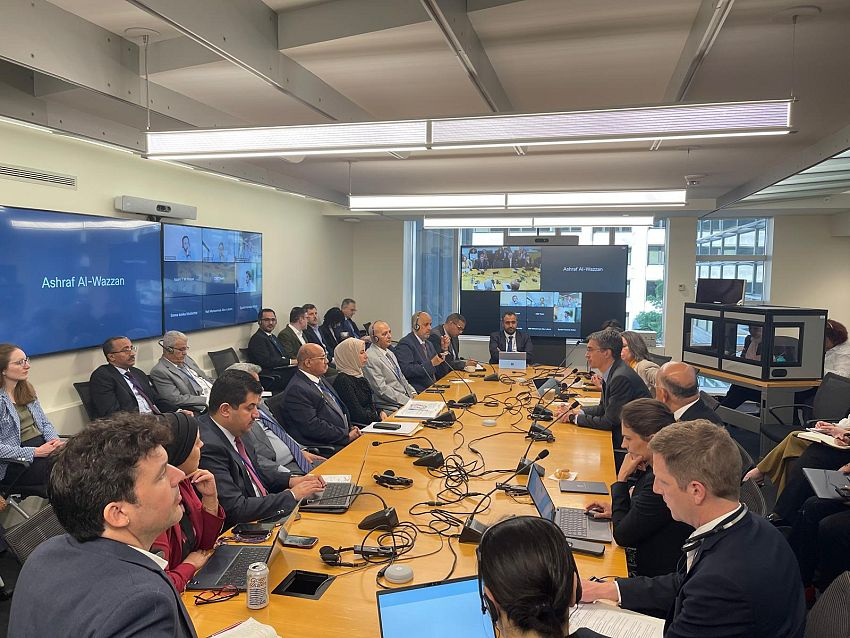
Yemeni Government Delegation and World Bank Review FY2026 Project Pipeline
World Bank
Meeting
16/04/2026
Washington
The Yemeni government delegation participating in the 2026 World Bank Group and International Monetary Fund (IMF) Spring Meetings met today in Washington, D.C., with the World Bank’s country leadership team to review the pipeline of projects planned for the 2026 fiscal year across key development sectors.
The World Bank team presented the proposed project portfolio, which includes the Climate-Resilient Water Services Program, to be implemented in three phases; the Health, Nutrition, Water and Sanitation Project; the Cash for Nutrition and Livelihoods Project; the Public Institutions and Systems Modernization Project; and additional financing for the Integrated Urban Services Emergency Project.
The International Finance Corporation (IFC) also presented its investments in Yemen’s private sector, including plans to develop Sharia-compliant financial products to expand access to finance for small and medium-sized enterprises (SMEs).
Minister of Planning and International Cooperation, Dr. Afrah Al-Zouba, stressed the importance of ensuring that the new Country Partnership Framework (CPF) reflects the priorities of the Government of Yemen’s forthcoming National Development Plan. She emphasized that the framework should be based on a flexible implementation model that combines direct government implementation with third-party delivery arrangements where appropriate.
The Minister also called for the inclusion of a trade and trade facilitation project within the proposed portfolio to support customs modernization, port infrastructure, and the movement of essential goods, as well as a roads project to address critical infrastructure needs and improve connectivity between economic centers and governorates.
Dr. Al-Zouba further called for a gradual transition toward greater reliance on national institutions in project implementation. She also stressed the need to develop an exit strategy for fuel financing for hospitals and water facilities by linking it to sustainable energy solutions, while expanding private sector participation in line with the government’s public-private partnership agenda.
Governor of the Central Bank of Yemen Ahmed Ghaleb highlighted the Central Bank’s efforts to maintain monetary stability, manage the exchange rate, strengthen banking sector reforms, and combat money laundering and terrorist financing. He emphasized the need for increased international support to help Yemen mitigate the economic impact of ongoing regional developments.
Minister of Finance Marwan Bin Ghanem reaffirmed the government’s commitment to continuing reforms in public financial management, domestic revenue mobilization, and debt management. He stressed the importance of continued technical and financial support from the World Bank to strengthen fiscal resilience amid current challenges, as well as close coordination with the IMF on macroeconomic policy reforms.
For his part, the World Bank Country Director confirmed that the new Country Partnership Framework will be submitted to the World Bank’s Board of Executive Directors for consideration at the end of May, noting that an important pipeline of projects is currently being prepared with financing from the International Development Association (IDA).