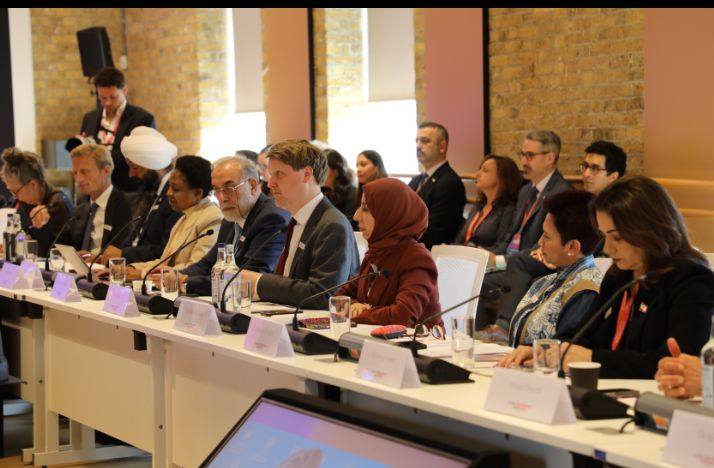
Minister of Planning Participates in High-Level Discussions on Food Security and Humanitarian Action at London Global Partnerships Conference
Global Partnerships Conference
Conference
21/05/2026
London
Minister of Planning and International Cooperation, Dr. Afrah Al-Zouba, participated today in a high-level session jointly organized by the United Kingdom and the African Development Bank Group on the sidelines of the Global Partnerships Conference in London. The session focused on the impact of the Iran crisis on global fertilizer markets, food security, and the international response required to address these challenges.
The session brought together the UK’s Permanent Under-Secretary at the Foreign, Commonwealth & Development Office, Nick Dyer; President of the African Development Bank Group, Dr. Sidi Ould Tah; African ministers of development and finance; representatives of the Food and Agriculture Organization (FAO), the World Food Programme (WFP), the World Bank, international financial institutions, and private sector representatives.
Participants examined the structural impact of the crisis on global supply chains for fertilizers, fuel, and food, amid an estimated 30 percent decline in global fertilizer trade and a more than 30 percent increase in urea prices.
The discussion also highlighted the growing fiscal pressures on food-importing countries and the need for anticipatory financing mechanisms that can respond before crises unfold rather than afterwards. Participants emphasized that the current crisis is not an isolated event but part of a broader pattern of recurring global shocks that requires countries to build long-term structural resilience.
In her intervention, Dr. Al-Zouba noted that Yemen is one of the clearest examples of a fragile, import-dependent economy, relying on imports for the vast majority of its basic food requirements. She explained that the effects of the current crisis are transmitted directly to Yemen through rising global prices, further intensifying the country’s existing economic and humanitarian challenges.
The Minister stressed that the real gap lies in the timing of international responses. While anticipatory action and pre-arranged financing tools already exist, she noted that they often arrive too late to prevent severe impacts. She called for earlier interventions in the world’s most vulnerable markets and greater support for domestic agricultural production by ensuring affordable access to agricultural inputs and quality seeds.
Dr. Al-Zouba also participated in the closed humanitarian session, co-chaired by Dr. Abdullah Al Rabeeah, Supervisor General of the King Salman Humanitarian Aid and Relief Centre (KSrelief), and UK Minister for Development and Baroness Jenny Chapman.
The session focused on protecting civilians and humanitarian workers amid rising violations of international humanitarian law, the need for more flexible and predictable humanitarian financing, expanding anticipatory and risk-financing mechanisms, and strengthening the role of humanitarian coordinators.
During the discussion, Dr. Al-Zouba reflected on Yemen’s experience over a decade of humanitarian operations, emphasizing that local communities are consistently the country’s first responders. She also highlighted the vital contribution of the Yemeni diaspora, particularly in Saudi Arabia, whose annual remittances exceed US$5 billion and provide critical support to millions of Yemeni families.
The Minister underscored the importance of strengthening national institutions and shifting towards more strategic and better-coordinated interventions, accompanied by clear exit strategies that enable Yemen to rely increasingly on its own institutions over the long term.
Participants across the session emphasized the need to place the protection of civilians back at the centre of humanitarian action, ensure adequate and sustainable financing for protection activities, strengthen the role of United Nations Resident and Humanitarian Coordinators in humanitarian negotiations and diplomacy, and reinforce accountability for violations committed against civilians and humanitarian workers.